01
Memorizes formulas
but forgets them later
Plug-and-chute recall works on homework night. It evaporates by test day, and re-learning each unit starts over from zero.
Nexus STEM Workshop helps students build deep understanding in quantitative reasoning, physics, and analytical problem solving — through derivation, conceptual clarity, and guided exploration, so they can approach unfamiliar problems with confidence.
If your student shows any of these patterns, the issue isn't effort — it's that the learning is skipping the understanding layer.
Plug-and-chute recall works on homework night. It evaporates by test day, and re-learning each unit starts over from zero.
Homework is a known problem with a known path. Tests present unfamiliar word problems — and the formula isn't enough to bridge the gap.
Pattern matching fails the moment the question doesn't match the example. Confidence collapses before the work even begins.
Steps are executed cleanly, but the student can't tell you what the equation means. There's no mental model — just a sequence.
AP Physics, AP Chem, competitions — the abstraction ramps up and the surface-level approach that used to scrape by stops working.
The pace rewards the prepared and punishes the curious. Time to think is the first thing cut when curriculum compresses.
Our Understand → Derive → Apply method replaces rote memorization with genuine comprehension — so students stop forgetting formulas, start handling unfamiliar problems, and build lasting confidence in STEM.
A three-part cycle that replaces memorization with reasoning. Each step builds the layer the next one needs.
We start with what a concept actually means. Students learn the meaning of velocity, energy, momentum — not the formula, but the intuition and the language. Conceptual clarity comes before symbols.
We pull formulas apart and rebuild them from first principles. When a student derives an equation, they own it. Derivation makes concepts memorable and reduces reliance on rote recall.
With understanding in hand, students practice reasoning through unfamiliar problems — not pattern matching. This is the adaptability that survives any test, any curriculum, any future.
Nexus STEM Workshop is a STEM enrichment program serving middle- and high-school students across Naperville and the western suburbs. Founded in August 2025, we were created to provide the kind of rigorous, connected, analytical learning experience that many students rarely encounter in a traditional classroom.
A short list of the things we do differently from standard tutoring.
Maximum 6 students per class. Instructors see every learner's thinking — and adjust in real time.
Every formula is built from first principles. Students know where equations come from, not just how to use them.
Math, physics, graphs, logic, and Python — taught as one connected system, not siloed subjects.
The teaching approach is designed and personally trained by the founder — high intensity, high personalization.
These are the structural choices that show up in every session, every worksheet, and every conversation we have with a student.
Teach the meaning behind every formula. Students learn to think, not just plug numbers.
Develop the ability to reason with numbers, interpret data, and model real-world phenomena mathematically.
Deconstruct problems from fundamental truths rather than accepting formulas at face value.
Every formula is derived, not declared. Students know where equations come from and why they work.
Tackle unfamiliar challenges through logical analysis — not memorized templates.
Python coding woven into problem solving — students model physics and verify math by writing it.
Every session at Nexus follows a consistent approach. Here's how it compares to what students typically experience.
Many programs focus on procedures, shortcuts, and test preparation. At Nexus, students learn where ideas come from, why methods work, and when they apply.
Rather than memorizing formulas, students learn to derive them. Rather than following recipes, students learn to understand the structure beneath the problem.
Our goal is not only to help students solve today's questions, but to develop the intellectual habits needed to tackle tomorrow's challenges.
Physics serves as the backbone of scientific reasoning. Mathematics provides the language. Programming provides the tools. Chemistry demonstrates real-world applications.
By connecting these disciplines rather than teaching them in isolation, students develop a deeper and more unified understanding of how the world works.
Acceleration alone does not create understanding. At Nexus, students are encouraged to slow down when necessary, ask deeper questions, and explore the assumptions behind what they learn.
We emphasize conceptual clarity, structured reasoning, and long-term mastery over short-term memorization.
Speed naturally follows understanding.
The future belongs to students who can analyze unfamiliar situations, construct models, and evaluate solutions.
These skills remain valuable regardless of how technology evolves.
Nexus classes are intentionally capped at six students. This is not a logistical limitation — it is a pedagogical choice.
Many of the most valuable learning moments occur when a student asks an unexpected question, challenges an assumption, or approaches a problem from a different perspective.
By keeping groups small, we create an environment where discussion, exploration, and individualized guidance become part of the learning process rather than exceptions to it. Every student is expected to think, participate, question, and contribute.
Because deep learning is rarely a spectator activity.
At Nexus, we believe that true understanding begins with fundamentals. Rather than relying solely on formulas, shortcuts, or memorized procedures, students learn to identify the underlying assumptions, relationships, and structures that govern a problem.
By breaking complex ideas into simpler components and rebuilding them step by step, students gain a deeper and more durable understanding.
This approach helps students become independent thinkers who can adapt their knowledge to unfamiliar situations, evaluate new ideas critically, and solve problems with confidence and creativity.
At Nexus STEM Workshop, curriculum and syllabus design are treated with exceptional care. We do not simply follow existing textbooks page by page. Instead, our instructors carefully curate, adapt, and organize academically rich materials from a wide range of sources, including college-level textbooks, MIT OpenCourseWare, past AP exam questions, and problems from major STEM competitions.
What makes the Nexus curriculum distinctive is its cross-disciplinary integration. Many concepts that are traditionally taught in separate math, physics, computer science, or engineering classes are brought together naturally through carefully designed lessons.

AI can increasingly solve routine textbook exercises. The differentiator — now more than ever — is the ability to reason through problems it has never seen.
Building strong mathematical and scientific foundations through conceptual understanding rather than repetitive drills. Where every student starts — whether preparing for AP exams or national STEM competitions.
Developing quantitative reasoning, problem-solving strategies, and mathematical maturity. For students ready to deepen their analytical toolkit and tackle more complex challenges.
Exploring deeper structures, advanced topics, and cross-disciplinary connections beyond standard school curricula. For students who want to see how everything fits together.
Physics serves as the backbone of scientific reasoning. Mathematics provides the language. Programming provides the tools. Chemistry demonstrates real-world applications. By studying these disciplines together rather than in isolation, students develop a deeper and more unified understanding of how the world works.
Four core subjects, each available across all three pathways — with structured syllabi you can review below.
Where questions become models
Many students encounter physics as a set of equations. At Nexus, we begin with questions — why does a ball fall? why do satellites remain in orbit? — and learn how observations become models, models become equations, and equations become powerful tools for understanding the world.
By studying physics, students learn far more than mechanics or electricity. They learn how to think.
A language of thought
Mathematics is more than computation. It is a language for describing patterns, relationships, and structures. Our mathematics programs emphasize reasoning, proof, modeling, and problem solving, helping students develop the intellectual tools needed for advanced STEM learning.
In the age of AI
Many parents ask: If AI can write code, why should students still learn programming? Because programming is no longer about memorizing syntax. It is about breaking complex problems into manageable pieces, designing logical systems, building mathematical models, and communicating ideas precisely.
Beyond memorization
Chemistry is often taught as a collection of reactions and equations. At Nexus, we emphasize the physical principles and mathematical relationships that explain why those reactions occur. Students learn to connect chemistry with physics, mathematics, and real-world systems.
Between classes, instructors answer follow-up questions by email. Parents can request regular progress reports — what was covered, what was strong, and where the next session will push. Up to 30 minutes of phone support is available each week for more immediate questions. The class is the spine; the support is the connective tissue.
Nexus was built for students who feel constrained by memorization. If your student is any of these, the work will resonate.
Asks "why" before "how." Wants to understand, not just complete the assignment.
Willing to spend an hour on a problem. Drawn to the underlying structure, not the surface.
Physics, chemistry, math, code — drawn to how the natural world works, and the tools to model it.
Preparing for advanced coursework, AP exams, or national STEM competitions like F=ma and AMC.
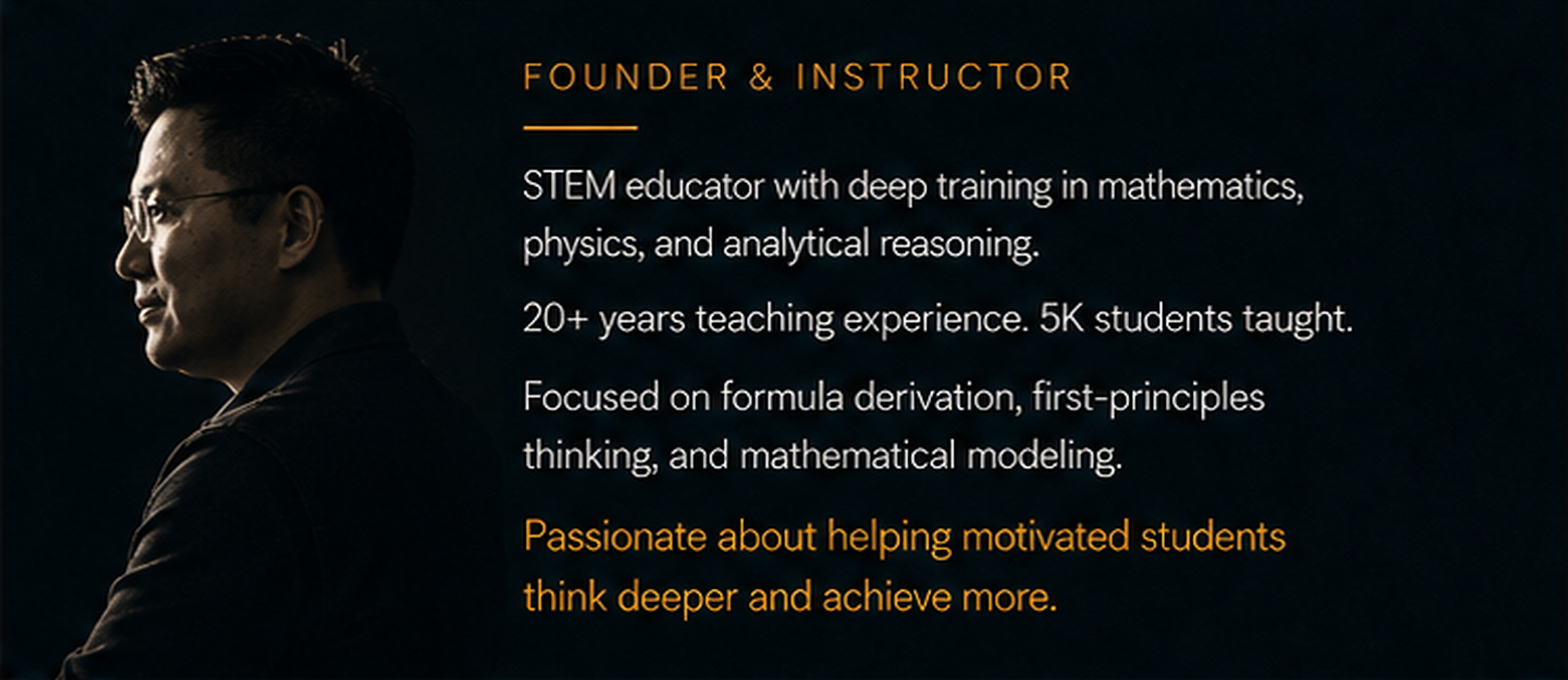 After teaching more than 5,000 students over two decades, we noticed a recurring pattern: Many students could apply formulas successfully, yet few truly understood where those formulas came from or why they worked. Nexus STEM Workshop was founded to bridge this gap. Our mission is to help students move beyond memorization and develop the ability to think critically, model complex systems, and discover connections across disciplines. Because deep understanding lasts longer than any exam score.Founder, Nexus STEM Workshop
PhD-level expertise across physics, mechanical engineering, polymer science, and chemistry. Sometimes two instructors teach in one session.
20+ years part-time teaching. 5,000+ students taught. Former management at major US consulting firms. Brings an interdisciplinary advanced STEM lens to AP Physics, F=ma, and AMC preparation.
10 years in industry developing multi-physics solvers in R&D. Currently Principal Engineer. Specializes in computational fluid mechanics and HPC. Code in Fortran, CUDA, C++, and Python. Passionate about making physics fun and relatable.
Chief Product Designer in the semiconductor industry. Applies chemistry to cutting-edge technology in her teaching. Known for an interactive, real-world style that connects abstract to applied.
Academic research and laboratory instruction. Semiconductor industry professional. Hands-on, adaptable across learning styles. Covers Gen Chem I & II, Spectroscopy, and Organic Chemistry.
Modern conference tables, comfortable chairs, and teaching equipment in a focused, permitted environment in Naperville, IL.
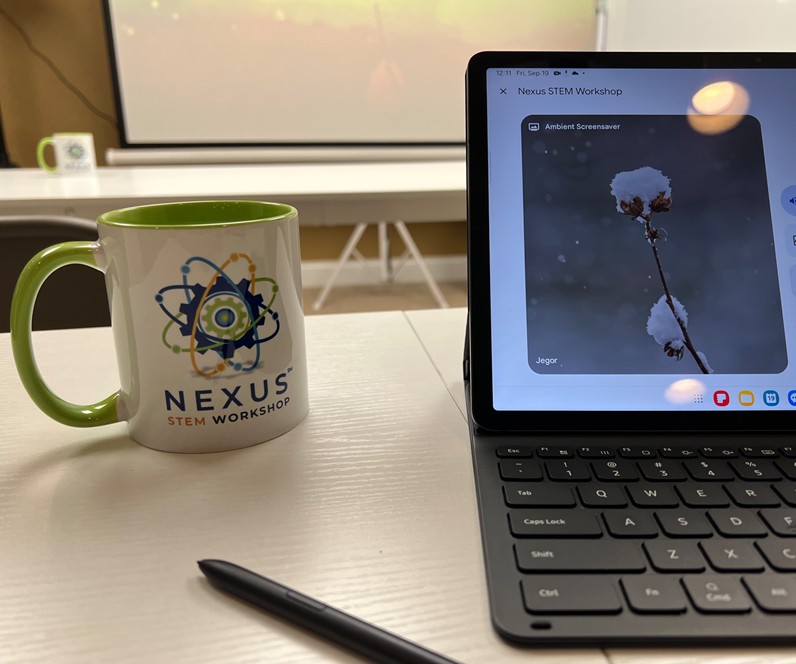
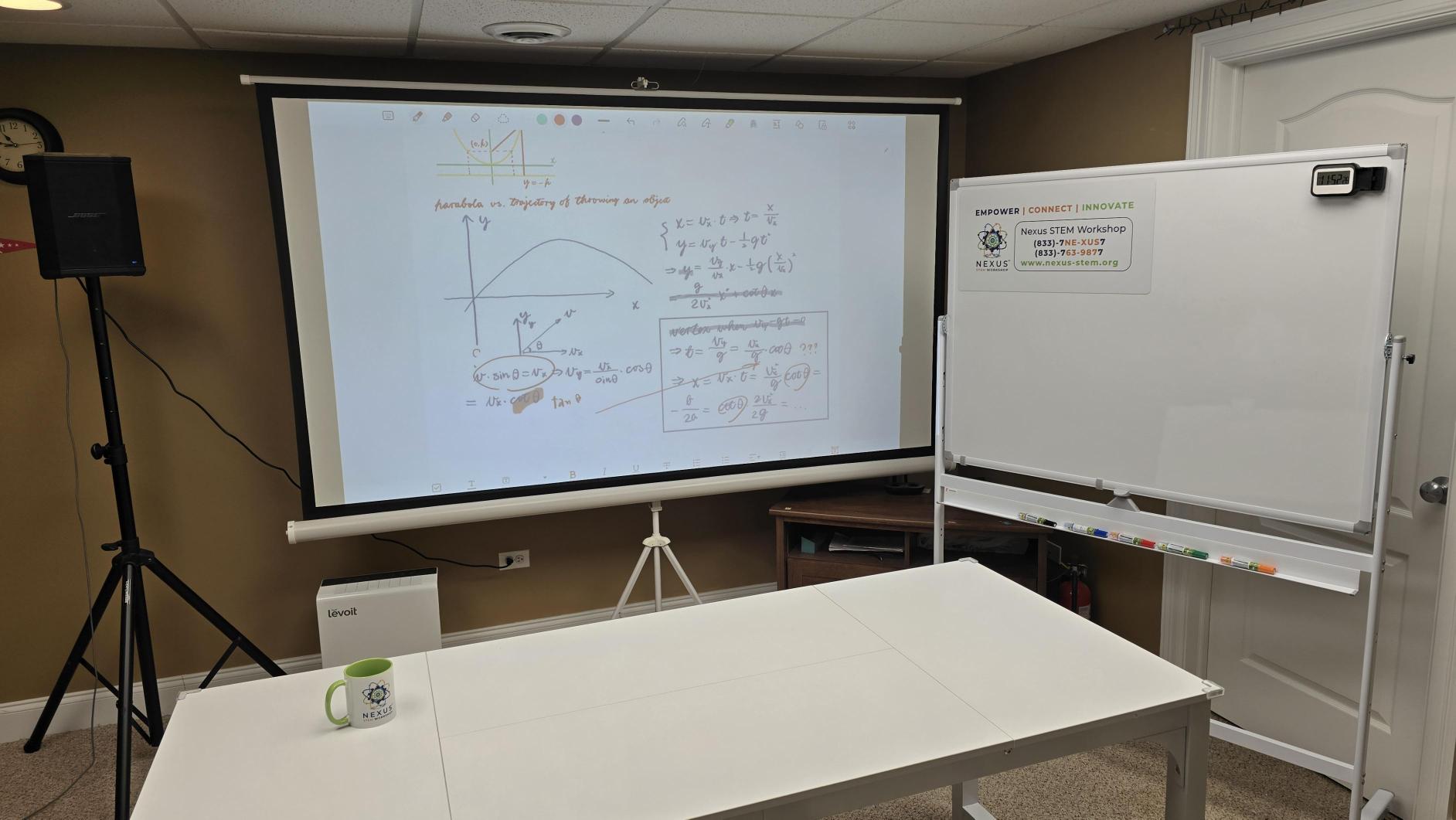
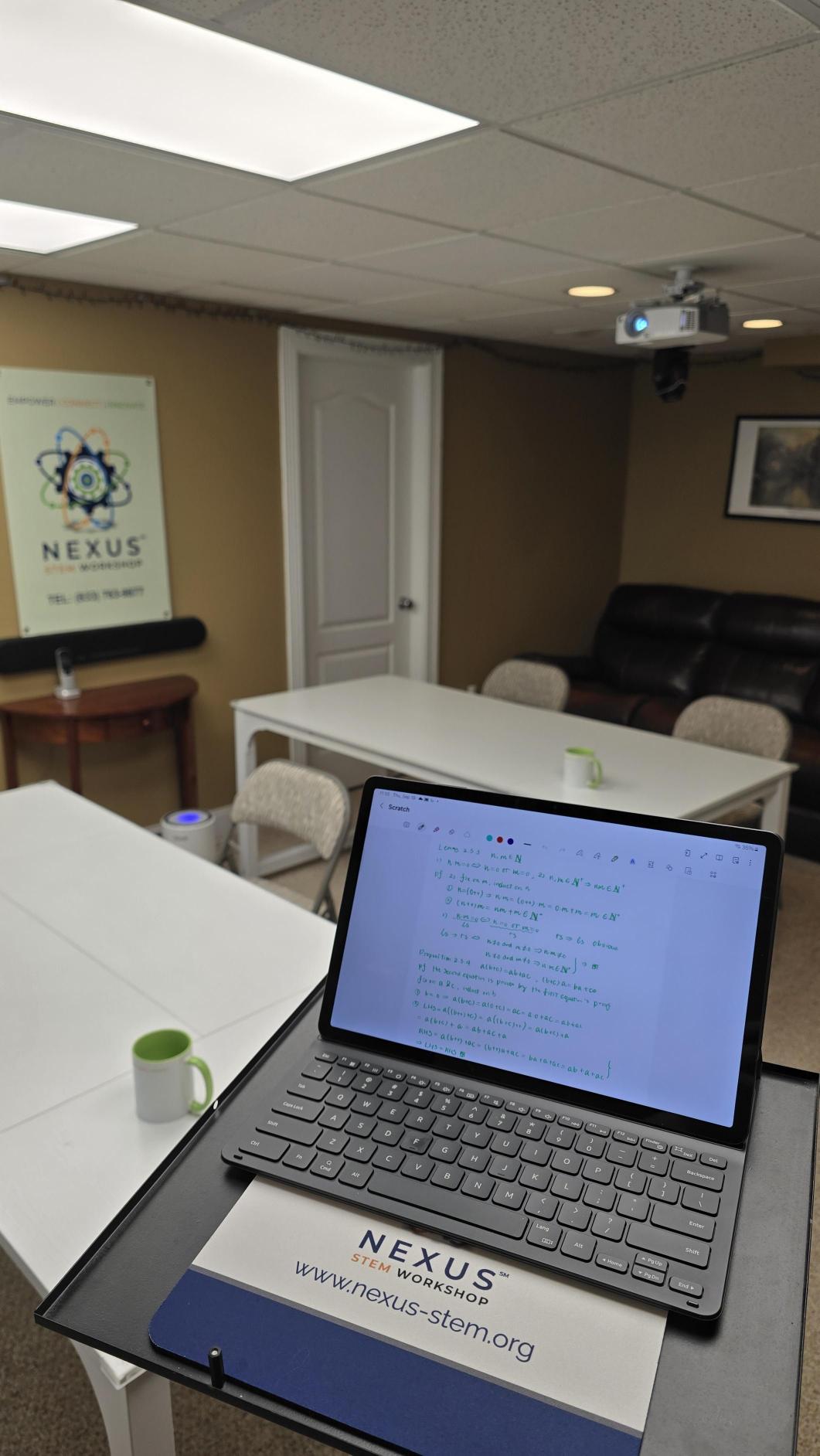
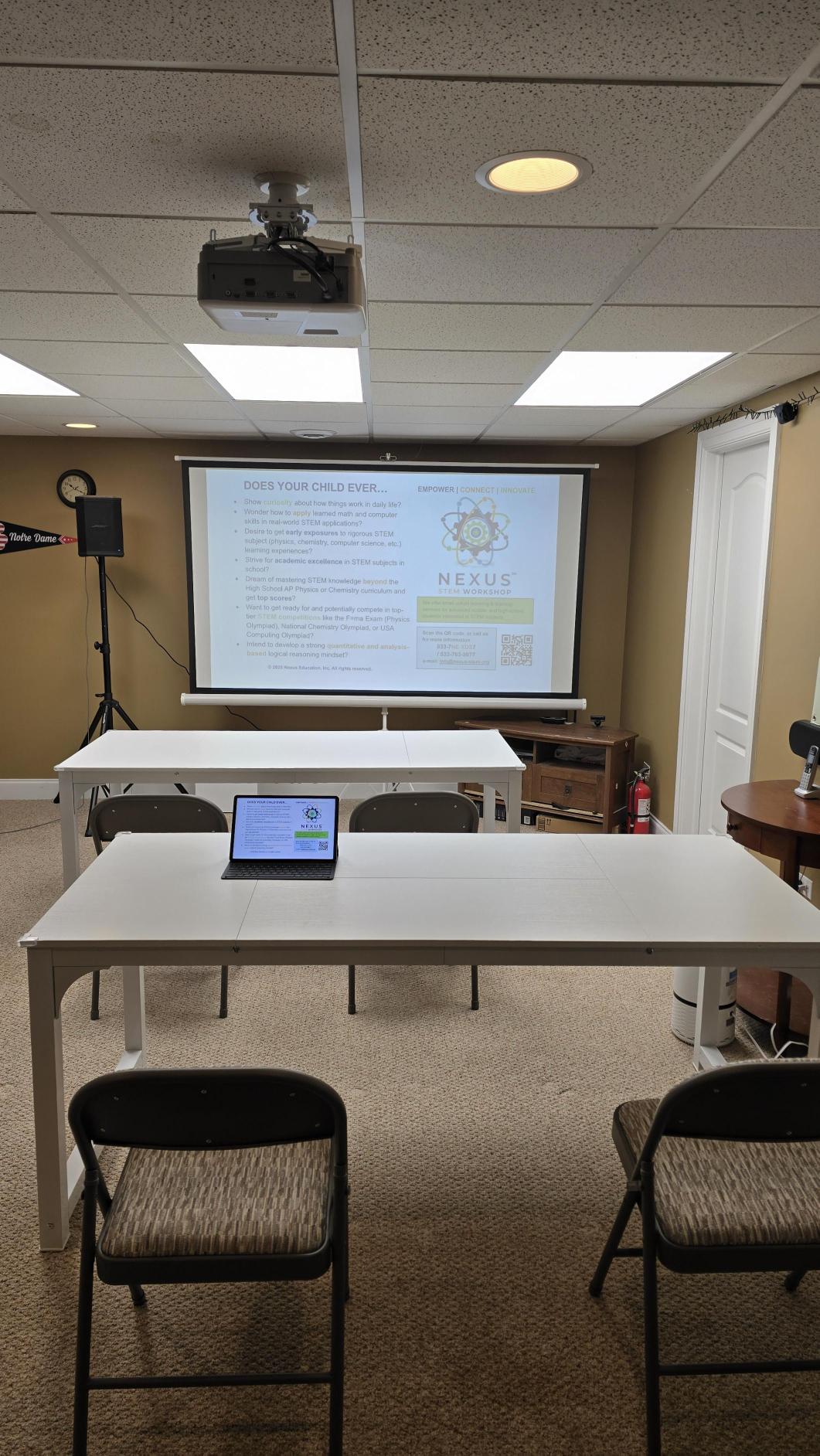
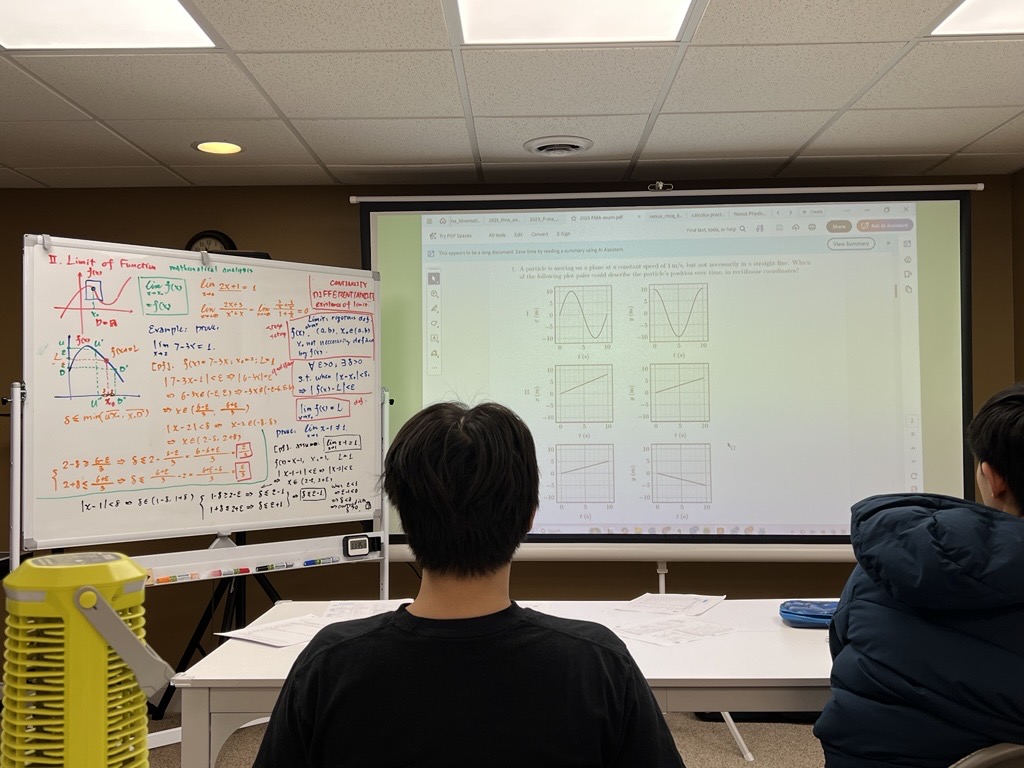
Enrollment is open on a rolling basis. Book a free trial session in Mathematics, Physics, Computer Programming, or Chemistry - no commitment, no pressure. Just thoughtful instruction, challenging ideas, and a real learning experience.
Questions about programs, scheduling, or fit? We respond to every inquiry — usually within a business day.
2203 Spartina Rd
Naperville, IL 60564
(708) 668-9073 — opt-in required
Upload your completed assignments below. We'll review your work and provide detailed feedback.